

Ureteral injury during laparoscopic rectal resection and concurrent laparoscopic repair by uretero-ureterostomy
1 INONU UNIVERSITY SCHOOL OF MEDICINE, DEPARTMENT OF GASTROENTEROLOGY SURGERY, MALATYA, TURKEY
2 INONU UNIVERSITY SCHOOL OF MEDICINE, DEPARTMENT OF RADIOLOGY, MALATYA, TURKEY
3 ÖZEL ANKA HOSPITAL, DEPARTMENT OF SURGERY, GAZIANTEP, TURKEY
4 YEDITEPE UNIVERSITY SCHOOL OF MEDICINE, DEPARTMENT OF SURGERY, ISTANBUL, TURKEY
Abstract
Iatrogenic ureteral injury is an uncommon but severe complication of laparoscopic colorectal surgery. If it is detected intraoperatively, conversion to open surgery is usually inevitable. Here, we described a complete ureteral transection during laparoscopic low anterior resection, which was simultaneously repaired by laparoscopic uretero-ureterostomy. The most important points during the anastomosis of two tiny tubular tissues are dissecting the tubular organs without trauma, obtaining meticulous hemostasis without causing any necrosis, and achieving accurate approximation of tissues with the sutures. To the best of our knowledge, this is the first report that focused on laparoscopic repair of ureteral injury during laparoscopic colorectal surgery. As there are still few data on laparoscopic repair of ureteral lesions, no firm conclusions can be drawn. But, in appropriate cases, if intracorporeal suture expertise is available, laparoscopic repair can be done during colorectal surgery.
Introduction
Iatrogenic ureteral injury is an uncommon but severe complication of laparoscopic colorectal surgery. These injuries can be detected either during or after surgery. If it is detected intraoperatively, a conversion to open surgery is usually inevitable [1]. Here, we described a complete ureteral transection during laparoscopic low anterior resection by harmonic scalpel, which was simultaneously repaired by laparoscopic ureteroureterostomy. To the best of our knowledge, this was the first report that focused on the laparoscopic repair of a ureteral injury during laparoscopic colorectal surgery.
Case Presentation
A 48-year-old female was referred to our department after colonoscopy and biopsy that showed a 4-cm ulcerous mass in distance of 12 cm from anal verge with histological diagnosis of adenocarcinoma. Her body mass index was 26 kg/m2 and American Society of Anesthesiologists score was I. Computed tomography showed a thickened wall of the upper rectum without metastatic lesion or local invasion. No neoadjuvant chemoradiotherapy was given and laparoscopic rectal resection was planned.
The patient was placed in the Lloyd-Davis position and a urinary bladder catheter was inserted. Total five trocars were placed to the umbilicus and to four quadrants of the abdomen. Using the medial-to-lateral dissection method, the mesocolon was opened with a Ligasure (ForceTriad, Covidien, Boulder, CO, USA) along Toldt’s line. Inferior mesenteric artery was exposed and sealed twice and cut close to root by Ligasure. During the dissection of Toldt’s line towards the inferior mesenteric vein, a hemorrhage occurred in the fascia. The bleeding area was aspirated, irrigated and the bleeding vessels were coagulated with Ligasure. Further dissection was moved to find out the left ureter an it was found over the left iliac artery. However, its proximal part was absent. When the proximal stump was examined, it was found in the previously coagulated area. The left ureter had been mistaken for bleeding blood vessel in the Toldt’s fascia and had been sealed and transected. The proximal and distal parts of the ureter was separated from the surrounding tissues to provide a tension-free anastomosis. Both stumps were trimmed off by endoscopic scissors. A double-J catheter (6 French in diameter and 26 cm in length) was inserted into the abdomen through the 12 mm laparoscopic trocar and placed into the divided proximal and distal lumens of the ureter (Figure 1a). An end-to-end uretero-ureterostomy over this catheter was fashioned by five interrupted 5/0 polydiaxone sutures (Figure 1b). Sutures were placed through the full thickness of the ureteral wall and they were knotted intracorporeally. Laparoscopic low anterior resection was completed as described before [2]. Finally, two abdominal drains were placed to the left retroperitoneal area and pelvis.
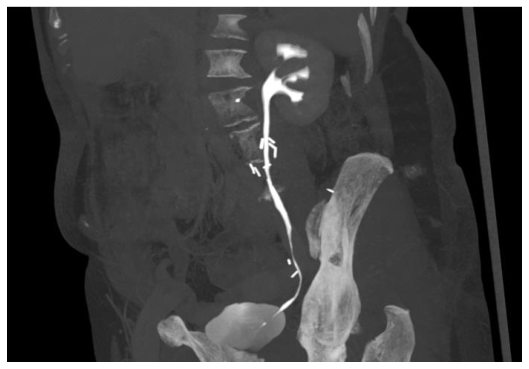
The postoperative period was uneventful and the patient was discharged on day five with bladder catheter. The urinary catheter was removed on day eight. The histological analysis showed a pT3pN1 lesion and the patient was referred to medical oncology department. Urinary ultrasound revealed no ureteral dilatation and double J catheter was removed by the urologist under cystoscopy on postoperative third month. After 33 months follow-up, the patient had no urinary complaints, normal kidney functions. Her 3D computerized tomography demonstrated normal ureteral view at both sides (Figure 2).


Discussion
Here, an immediate laparoscopic repair of a ureteral injury during laparoscopic rectal resection has been described. Previously, gynecologists reported similar experiences in their specific operations [3]. Han reviewed the laparoscopic repairs of total 38 ureteral injuries during gynecological laparoscopic procedures [4]. At this review, the laparoscopic primary repair of ureteral injury was found as successful in 86.1%. They suggested that laparoscopic uretero-ureterostomy could be considered in transections of the ureter where technical expertise is available. We had experience of more than 500 laparoscopic handsewn anastomoses from our ongoing bariatric surgery program [5]. This experience encouraged us to make this laparoscopic end-to-end uretero-ureteral anastomosis.
In open surgery, four types of ureteral injuries according to the base of the mechanisms were described: laceration by sharp instruments, ligation by sutures, crushing by clamps, and devascularization by cautery [6]. The increasing availability of new energy devices at laparoscopic
surgery
accelerated the numbers of laparoscopic colorectal surgery by reducing the length of surgery and blood loss. An energy device itself can cause a complex injury with combined mechanisms such as thermal devascularization, crushing, sealing and dividing at one heat. Here, we transected the left ureter by harmonic scalpel and it crushed, occluded and transected it. After transection, there was no urinary leak through the stumps. When the ureteral injury was recognized, the sealed ureteral stumps were refreshed and then we saw the urinary drainage. We learned that if there was a ureteral division by an energy device, a urine leakage at the surgical area could not appear immediately.
The term of “conversion” from laparoscopy to open means that continuation of laparoscopic surgery is no longer feasible. Although conversion itself is not a complication of laparoscopy, it has the increased risk of complications which are related to laparotomy, increase in operating time and the reasons of conversions as intraoperative complications or severity of abdominal problems [7]. It was reported that laparoscopic-converted colon resections were associated with significantly greater morbidity, particularly wound complications and greater length of hospital stay, compared to open or laparoscopic colectomies [8]. In 2012, Kang and associates reported the results of Nationwide Inpatient Sample data including 43,165 laparoscopic and 7,545 converted colorectal procedures and pointed out that converted surgery was independently associated with anastomotic leak, wound infection, ileus or obstruction, and urinary tract infection [9]. They concluded that the use of laparoscopy should increase with efforts to minimize conversion. If the surgical team has an experience on advanced laparoscopic techniques, some intraoperative complications can be managed safely with good outcomes by avoiding conversion. Laparoscopic remedy of intraoperative problems allows continuation of the benefits of laparoscopic surgery. The most important points during the anastomosis of two tiny tubular tissues are dissecting the tubular organs without trauma, obtaining meticulous hemostasis without causing any necrosis, and achieving accurate approximation of tissues with the sutures [10]. All these points can be performed as laparoscopic techniques; moreover, magnification with modern video cameras allows laparoscopic suturing of the tiny tubular organs under optimal conditions.
Conclusions
Because there is still a paucity of data about the laparoscopic repair of ureteral injuries, any firm conclusion cannot be drawn. But in suitable cases, if intracorporeal suturing expertise is available, laparoscopic repair can be done during colorectal surgery.
Institutional Review Board Statement
Any aspect of the work covered in this manuscript has been conducted with the ethical approval of all relevant bodies and that such approvals are acknowledged within the manuscript.
Conflicts of Interest
There are no known conflicts of interest in the publication of this article. The manuscript was read and approved by all authors.
References
- Zhang X, Wang Z, Zhou H, Liang J, Zhou Z. Analysis of ureteral injuries for laparoscopic rectal cancer surgery. J Laparoendosc Adv Surg Tech A. 2014 Oct;24(10):698-701. doi: 10.1089/lap.2014.0028
- Kayaalp C, Yagci MA, Sumer F. Transanal extracorporeal anvil fixation to the proximal colon during laparoscopic rectal resection. Asian J Endosc Surg. 2015 May;8(2):226. doi: 10.1111/ases.12156
- Han CM, Tan HH, Kay N, Wang CJ, Su H, Yen CF, Lee CL. Outcome of laparoscopic repair of ureteral injury: follow-up of twelve cases. J Minim Invasive Gynecol. Jan-Feb;19(1):68-75. doi: 10.1016/j.jmig.2011.09.011
- Saidi MH, Sadler RK, Vancaillie TG, Akright BD, Farhart SA, White AJ. Diagnosis and management of serious urinary complications after major operative laparoscopy. Obstet Gynecol. 1996 Feb;87(2):272-6. doi: 10.1016/0029-7844(95)00411-4.
- Kayaalp C, Sumer F, Abdullayev A. Laparoscopic Roux-en-Y Gastric Bypass. Laparosc Endosc Surg Sci. 2016;23(4):110-118. doi: 10.14744/less.2014.29392
- Brandes S, Coburn M, Armenakas N, McAninch J. Diagnosis and management of ureteric injury: an evidence-based analysis. BJU Int. 2004 Aug;94(3): 277-89. doi: 10.1111/j.1464-410X.2004.04978.x
- Masoomi H, Moghadamyeghaneh Z, Mills S, Carmichael JC, Pigazzi A, Stamos MJ. Risk factors for conversion of laparoscopic colorectal surgery to open surgery: does conversion worsen outcome? World J Surg. 2015 May;39(5):1240-7. doi: 10.1007/s00268- 015-2958-z
- Belizon A, Sardinha CT, Sher ME. Converted laparoscopic colectomy: what are the consequences? Surg Endosc. Jun;20(6):947-51. doi: 10.1007/s00464-005-0553-3
- Kang CY, Chaudhry OO, Halabi WJ, Nguyen V, Carmichael JC, Stamos MJ, Mills S. Outcomes of laparoscopic colorectal surgery: data from the Nationwide Inpatient Sample 2009. Am J Surg. 2012 Dec;204(6):952-7. doi: 10.1016/j.amjsurg.2012.07.031
- Bissonnette F, Lapensée L, Bouzayen R. Outpatient laparoscopic tubal anastomosis and subsequent fertility. Fertil Steril. 1999 Sep;72(3):549-52. doi: 10.1016/s0015-0282(99)00284-8
